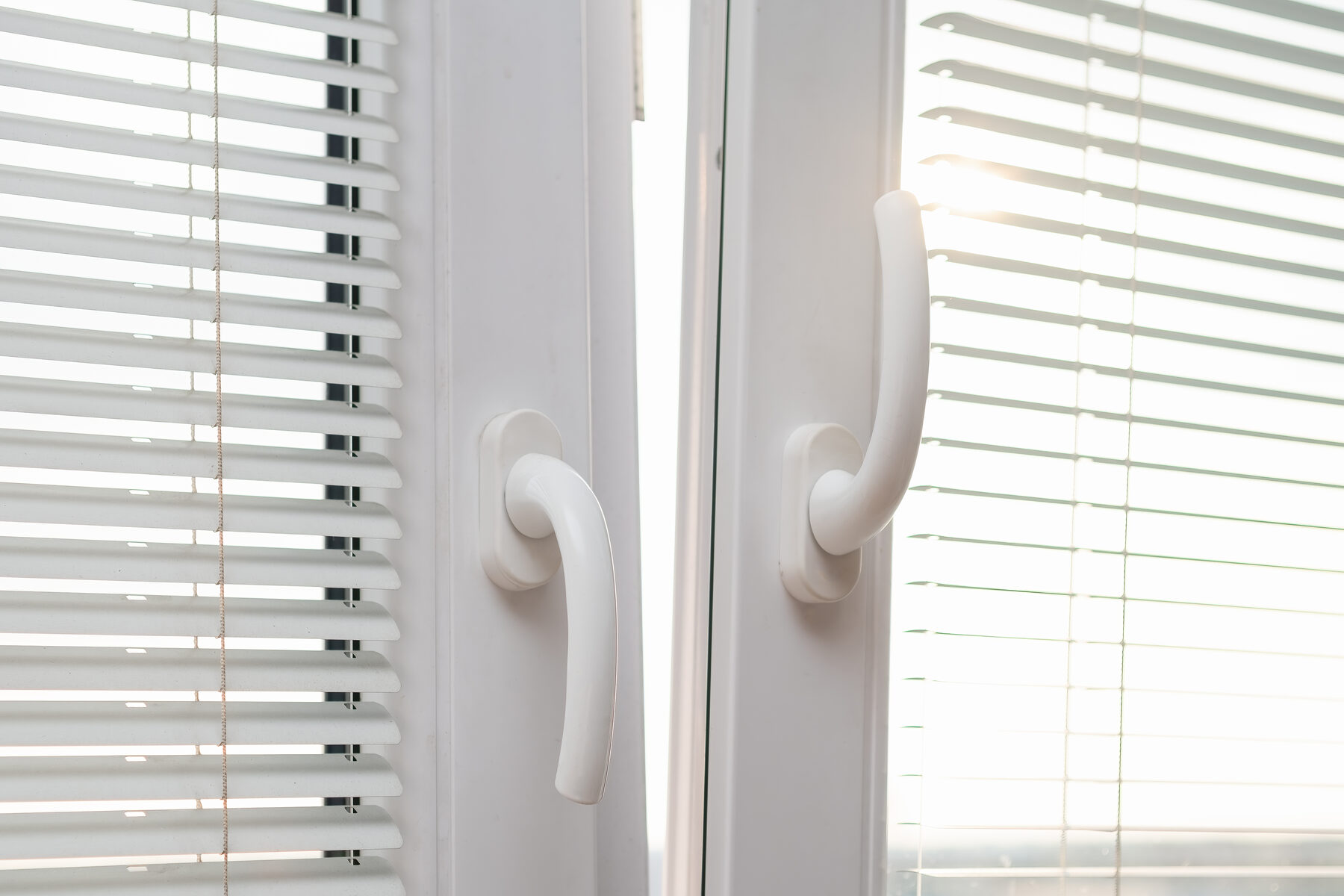
Basculante, oscilobatente and oscilo-paralela sound alike and are different windows. On a Portuguese quote, one word can mean a window that does not open sideways, or one that opens only part of the gap. This guide defines each type, compares them and says what to ask before you pay.
What each name means
| Name (pt) | In English | How it opens |
|---|---|---|
| Basculante | hopper, tilt-only window, tilt window | Only tilts: the sash turns at the bottom and the top moves into the room |
| Oscilobatente | tilt and turn | With one handle, opens sideways or tilts at the top |
| Oscilo-paralela | tilt and slide | Tilts at the top and also slides, parallel, behind a fixed part |
| Batente | turn-only, side-hung | Only opens sideways, like a door |
| Correr | sliding | The sash slides on a track |
Other names you may see: projetante (hinged at the top, the bottom swings out; awning in English), pivotante (pivots on two opposite points) and guilhotina (sashes move up and down; see old sash windows). Someone searching for a “window that opens upwards” may mean the projetante or the basculante.
Watch the word “tilt”. A “tilted window” is simply a window in its tilt position. In the US, “tilt-in windows” are usually double-hung windows whose sashes tilt in so you can clean the glass (Alside, 2023). That is not a tilt-and-turn window.
Watch the name basculante too. The manual of one window maker (Finstral, in Portuguese) uses “basculante” also for the tilted position of the oscilobatente, and “tilt-only hardware” for hardware that only tilts. If the quote says only “basculante”, ask for the drawing with the opening direction.
Tilt-only (basculante, hopper)
- Pros: simple, takes little room and gives basic ventilation. A German portal (Aroundhome, 2025) says it is enough for secondary rooms such as bathrooms and cellars.
- Cons: it does not open the gap, the outer glass is hard to clean and the view is limited. The same source warns that a tilted window can be forced with tools even when locked, mostly on the ground floor, and that cats and small dogs can get trapped in the gap.
Tilt and turn (oscilobatente)
- Pros: ventilates with a gap or opens the whole gap. English Wikipedia says it is the most common opening in Germany. With the sash open you can reach the outer glass from inside. See the tilt and turn guide.
- Cons: more complex hardware. Aroundhome says it is more prone to faults than a tilt-only window. BauNetzWissen lists what wears it: obstacles in the sash path, wind gusts, extra weight and dirt in the rebate. The open sash takes room inside.
Tilt and slide (oscilo-paralela)
- Pros: takes no room inside the home and gives a gap for airing. It is mostly used on balcony doors.
- Cons: like a sliding window, it opens only part of the gap: see sliding windows. Makers cap the sash weight. Maco’s system goes to 160 or 200 kg, Winkhaus (primePort SK) to 220 kg and Roto (Alversa) to 160-200 kg, depending on the series.
- How one maker uses it: in Finstral’s manual, the handle at 180° up tilts the sash, and at 90° it releases the sash from the frame to slide. Other makers use another order.
Quick comparison
| Tilt-only | Tilt and turn | Tilt and slide | |
|---|---|---|---|
| Opens the whole gap | No | Yes | Part of the gap |
| Room needed inside | Little | Yes | None |
| Cleaning the outer glass | Hard | Easier | Not confirmed |
| Hardware | Simpler | Complex | Complex, heavy sash |
| Wear | Fewer moving parts | Weight and use | Weight and rollers |
No source I read compares the price of the three with Portuguese figures. Ask for quotes of the types you want, at the same size, and compare: questions for the installer.
Air and water leaks
A tilted sash does not seal like a closed one. Finstral’s manual says that in the tilted position the window does not meet the requirements for airtightness, rain tightness, sound insulation, thermal insulation and burglary resistance. If you want quiet or no wind, close the sash. How well the closed window seals depends on the system and the installation, not only on the type.
Security
- Tilted position: German police, quoted by Aroundhome (June 2026), say tilted windows, mainly on the ground floor and in cellars, open in seconds with simple tools. They advise closing and locking everything when you go out.
- Lockable handle: Finstral has a model where the window tilts first and is unlocked with a key to open sideways.
- Protection against wrong operation: it stops the handle going from tilted straight to the sideways opening, which would leave the sash hanging on the bottom only (BauNetzWissen). If the handle will not move, see tilt-and-turn windows that will not open or close.
- RC classes: makers say some hardware gives RC 2 in the airing position (Roto when tilted, Winkhaus with a 6 mm gap, Maco). These are the makers’ claims. The standard and what to ask for are in security windows, RC classes.
Which window for which room
| Room | What usually works |
|---|---|
| Kitchen | Tilt-only or sliding if a worktop sits in front of the sash; tilt and turn if there is room |
| Bedroom | Tilt and turn, for airing at night. On the ground floor, close it when you go out |
| Stairs | Tilt-only, if the window is high and space is short (our own reasoning, no source) |
| Bathroom | Tilt-only (source: Aroundhome) or tilt and turn |
| Balcony door | Tilt and turn or tilt and slide |
The table is a starting point. Measure the free space (how to measure windows) and see the opening types guide.
What to ask in the quote
- Type and drawing: “basculante”, “oscilobatente” or “oscilo-paralela”, with the opening direction of each sash.
- Hardware brand and series, and whether they meet EN 13126-8, which covers durability, strength, security and function.
- Opening cycles: ask whether there is an EN 1191 test and the class. According to Peutz, the standard classifies from C0 to C5, with C5 equal to 200,000 cycles. If the maker does not publish the class, ask for that in writing.
- Maximum weight and size of the sash.
- Summer and winter gap (Finstral has an option: 17 cm in summer, 4 cm in winter).
- A handle with a key and protection against wrong operation.
- Maintenance and what the warranty covers: window maintenance.
What I could not confirm
- Cycle values per class of EN 1191 and EN 13126-8, and cycles published by Maco, Siegenia, Roto, GU or Winkhaus for these types.
- Relative prices of the three types in Portugal. The 2008-2009 forum threads I found are not a source.
- Whether “basculante” means the same drawing for every brand and across the country.
- The exact handle sequence of the tilt and slide of Siegenia, Roto and GU.
- How the PSP (Portuguese police) sees tilted windows.
Sources
- Wikipedia: Window and Casement window, read on 25.10.2026: type names only.
- Aroundhome: Kippfenster und Dreh-Kippfenster (updated 26.08.2025) and Polizei warnt vor gekippten Fenstern (30.06.2026): a company portal.
- Finstral: handling and safety instructions, windows (2021 file).
- Alside: Care and operation brochure (December 2023): tilt-in double-hung sashes.
- BauNetzWissen: Drehkippbeschläge and EN 13126-8, undated.
- Maco: Slide and tilt, undated brochure. Winkhaus primePort and parallel position (undated). Roto: Quadro Safe (26.02.2021) and Patio range (31.03.2026).
- Peutz: EN 1191, undated.
What to do next
- Compare offers with the quote checker.
- Get an estimate with the calculator.
- If a tilt and turn window is failing: what to do.