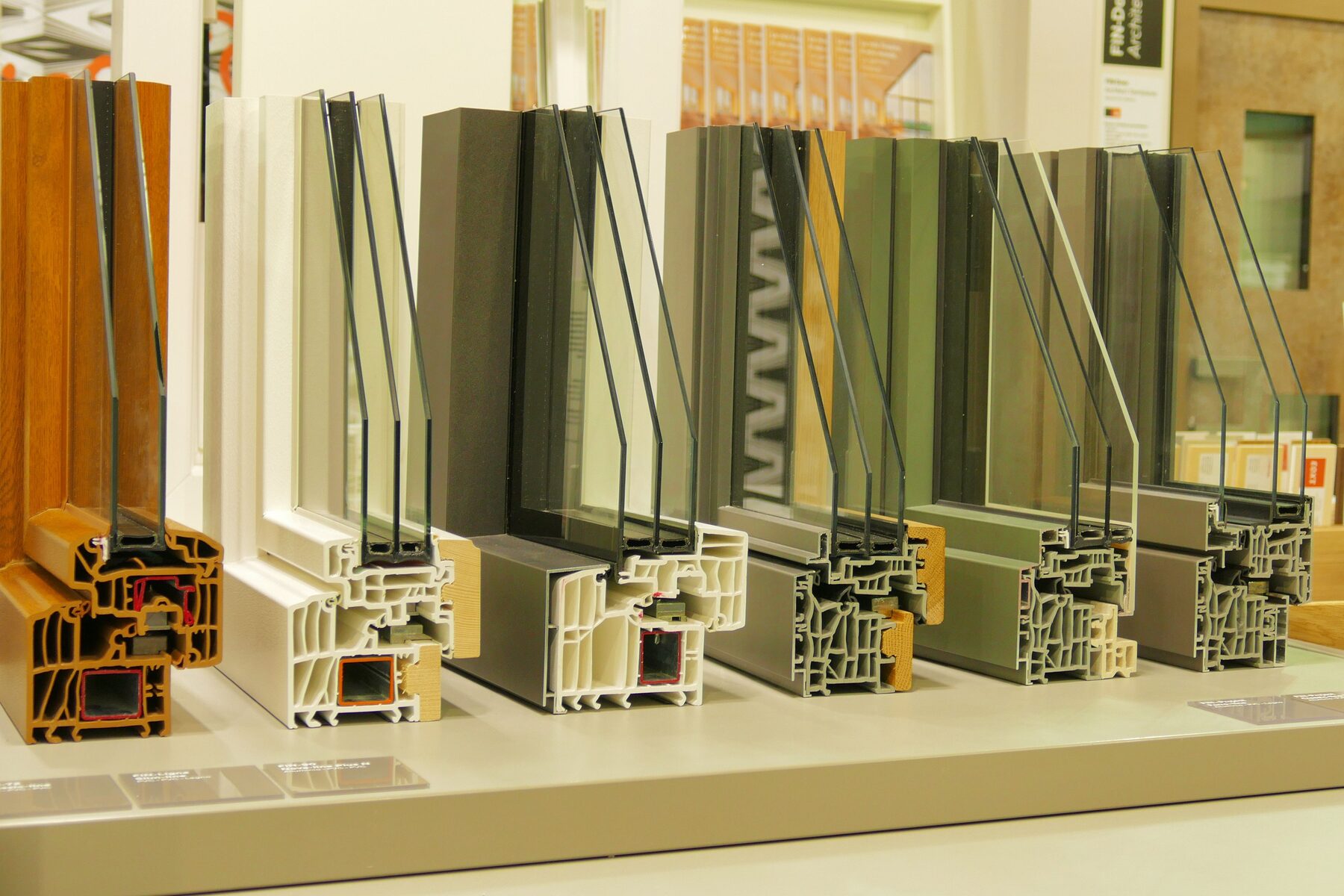
Aluminium has a bad name in the cold, and for good reason: a solid aluminium profile conducts heat very well. The thermal break (in Portuguese corte térmico or rutura térmica) was invented to fix that. Today it is common, but not every system has one, and quality varies from one to another.
This guide explains what it is, what changes day to day and what to ask. For the general comparison between materials, read PVC vs aluminium. Here we stay with aluminium only.
How a thermal break works
An aluminium window with a thermal break has two profiles: one on the inside and one on the outside. Between them sits a strip of rigid plastic, usually polyamide, that joins them. Heat has to cross that strip to get from one side to the other, and it crosses with great difficulty.
A concrete example: in a calculation report from the German institute ift Rosenheim, one aluminium system uses a strip made of polyamide 6.6 with 25% glass fibre. The design and material of the strip vary from system to system.
The strip is not only insulation. It has to hold the two halves of the profile together, in wind, sun and cold. That is why there is a standard just for this, EN 14024, which covers the mechanical strength of metal profiles with a thermal barrier.
What changes in practice
The cold that comes through the frame
Aluminium conducts heat very well: Wikipedia gives over 200 W/m·K, against about 1 W/m·K for timber. With no break, the cold outside reaches the inner side of the profile and the frame feels icy to the touch.
The Uf
Uf measures how much heat passes through the frame (the border only, without the glass). The lower, the better. Uw is the value for the whole window, frame and glass. An ift Rosenheim report for a polyamide-break system gives a Uf between 2.2 and 2.6 W/(m²K), calculated under EN ISO 10077-2. It is an example of one system, not a market average. We found no official Portuguese source with typical values, so always ask for the figure of the system you are offered.
Condensation on the frame
Condensation appears when warm, humid air touches a cold surface. A frame with no thermal break is one of those surfaces. With a break, the inner side stays warmer and less water runs down the profile. It does not end condensation: if the home is humid and poorly ventilated, it will still appear on the glass. See Window condensation.
Slim lines, large openings and the sea
More glass, less frame
Aluminium is stiff, so it can use narrow profiles. In balcony doors and big windows that means more glass and less frame. If you want a wide opening, see also sliding windows. Ask to see a cross-section drawing of the profile, not only a photo of the closed window.
Near the sea
Salt attacks aluminium and steel parts. In coastal towns, the finish matters as much as the thermal break.
- Lacquering (powder coating): a quality scheme called Qualicoat has a “Seaside class” for places within 5 km of the sea. It requires deeper surface preparation (the minimum aluminium removed goes from 1 to 2 g/m²) and the coater needs a separate licence.
- Anodising: another finish for aluminium, instead of lacquer. Ask the maker how it behaves by the sea and what upkeep it needs.
Ask what the finish is, whether it is certified and what warranty covers corrosion near the sea. Ask what the screws and hardware are made of too.
Cleaning
Fresh water and mild detergent, regularly, no hard scouring pads. Ask for the maker’s cleaning instructions in writing, and whether the warranty depends on them.
How to read the quote
A line like “aluminium window, white, double glazing” tells you nothing. Look for:
- The system name and the maker (the “series”). That is what you use to ask for the data sheet.
- Whether the profile has a thermal break and what the strip is made of. Not every system has one.
- The width of the strip. It is a figure the maker states. But what counts is the Uf of the whole system, not the width alone.
- The glass: type, thickness and whether it has a Low-E coating (an almost invisible layer that cuts heat loss). See Double glazing, Low-E and argon.
- The finish and colour, inside and outside.
- Compliance with EN 14351-1, the European standard for windows and external doors, with CE marking. The standard is the same for every material.
What pushes the price up or down
We give no figures, because we did not verify any from a source. What usually moves the price: the size of the opening, the system chosen (the series, the profile thickness and the thermal break), the glass, the colour (special colours or two colours), the hardware, the opening type and the installation. For the detail, use the quote checker and the calculator.
Aluminium or PVC: when each
Aluminium with a thermal break is a good choice when:
- the opening is large (balcony door, living-room window);
- you want a slim frame;
- the home is on the coast and the finish is good;
- you want a less common colour.
PVC is usually better when:
- the opening is a common size and you do not need slim lines;
- you want a frame that insulates well by nature, without comparing systems;
- you would rather not worry about salt and finish.
In a room you heat, aluminium with no thermal break leaves the frame cold and is hard to justify. If a quote does not mention the break, ask. To compare fairly, ask for both quotes with the same size and the same glass. See also what the CLASSE+ label is.
Questions for the installer
- What is the system and the maker? Can I have the data sheet?
- Does the profile have a thermal break? Made of what, and how wide?
- What is the Uf of the frame and the Uw of the whole window? Calculated under which standard?
- Is the connection between the two halves of the profile tested (EN 14024)?
- What is the finish? Is it certified? Is it suitable for the seaside?
- What are the hardware and screws made of?
- Does the warranty cover the finish and corrosion? For how long, in writing?
- Does the quote include sealing around the window, the sill and the shutter box?
More in 10 questions for the installer. To understand the numbers in a proposal, read How to read a window quote.
Sources
- Wikipedia: Thermal bridge: conductivity of aluminium (over 200 W/m·K), condensation on cold surfaces and thermally broken frames.
- ift Rosenheim: Uf calculation report, system AL 450: polyamide 6.6 strip with glass fibre and a Uf of 2.2 to 2.6 W/(m²K) under EN ISO 10077-2 (one system only).
- EVS: EN 14024:2023: the standard for mechanical strength of metal profiles with a thermal barrier.
- Intertek: EN 14351-1: scope of the standard for windows and external doors, the same for all materials.
- Glass Times: Qualicoat Seaside Class: a class for places within 5 km of the coast and deeper surface preparation.
What to do next
- Measure the openings: How to measure windows.
- Compare proposals: quote checker and calculator.
- If the problem is water on the frame or glass: Window condensation.