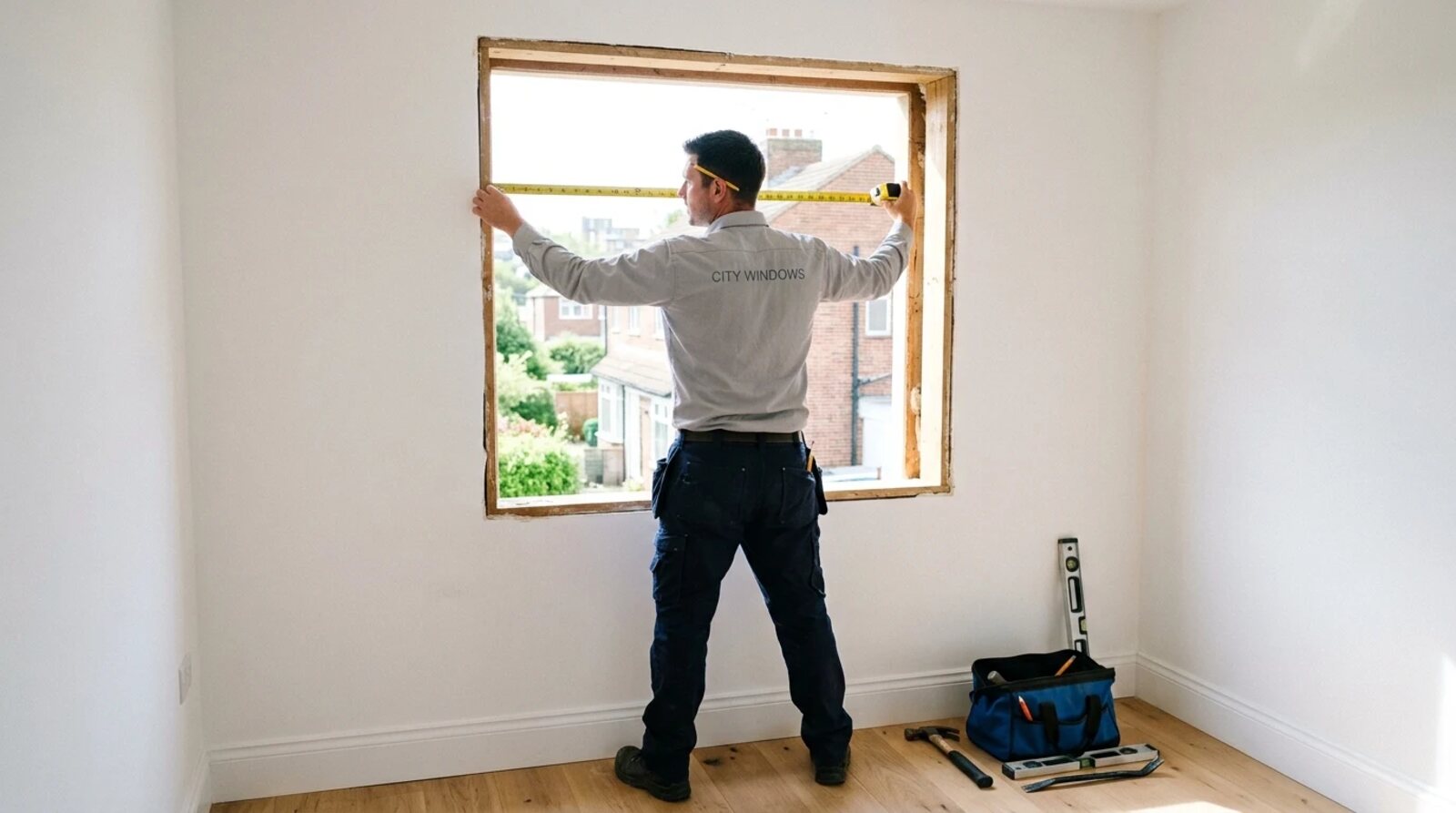
To ask for a quote you do not need perfect measurements. You need approximate measurements and a few notes. The installer confirms everything on site before the window is made. Even so, measuring well saves time, avoids surprises and helps you get prices that can be compared.
In this guide you get a step-by-step method, a list of what to note and the mistakes that come up most often.
What you need
- A tape measure (preferably a rigid, metal one)
- Paper and pencil, or your phone for notes and photos
- Five to ten minutes per window
- A small stepladder if the window is high (ask for help, do not measure off balance)
What to measure: the opening
The opening is the hole in the wall where the window sits. Measure the opening, not the glass. Do not measure only the part you see from inside either.
If the old window is still there, measure the whole window, frame included, from edge to edge. That works as an approximate size. The installer then confirms the exact size of the hole, after the old window is out.
Step by step
- Width: measure in three places: at the top, in the middle and at the bottom. Write down all three.
- Height: measure in three places: on the left, in the middle and on the right. Write down all three.
- Always use the same unit. Centimetres is the simplest.
- Write the width first and then the height. Example: 120 × 140 cm.
- If you can, also measure the two diagonals (from one corner to the opposite corner). If they are very different, the opening is out of square. Note it down.
- Measure the thickness of the wall, in other words the depth of the opening. It helps to work out how the window will sit.
Walls are rarely perfectly straight. That is why we measure in three places. If the numbers differ, write them all down. The installer knows what to do with them.
Example: width 119.5 at the top, 120 in the middle and 120.5 at the bottom. Height 140 on the left, 139.5 in the middle and 140 on the right. You write all six. You do not need to pick one.
What to note besides the sizes
- How it opens: to the side, inwards, sliding, tilt-and-turn (opens to the side and also tilts for airing). Look at the window from inside. See the options in Opening types.
- Opening side: seen from inside, are the hinges on the left or the right?
- Number of sashes: how many parts move.
- Shutter: is there a shutter box above? Do you want to keep it or change it?
- Sill: the stone or piece below the window. Is it damaged?
- Old window: does it need removing, and the rubble taking away?
- Colour and glass: the colour you want inside and outside, and whether you want double or triple glazing. See Double or triple glazing.
- Noise and cold: if your problem is noise or cold, say so. It changes the glass they will suggest.
Example: “Living room, sliding window with two sashes, opening 120 × 140 cm, with shutter box, old window is aluminium and needs removing. Noisy street.”
Balcony doors and special cases
For balcony doors, measure the height from the finished floor (or from the threshold, if there is one) to the top of the opening. Note whether there is a step on the way out. For attic windows, unusual shapes (arch, triangle) or several sashes joined together, do not guess: make a simple hand drawing with the size of each side and take photos. The installer takes care of the rest.
Photos
Take a photo of each window from inside and another from outside, if you can. They help the installer understand what is there. Also take a close-up of the corner and the sill, and one of the wall around it (if there is damp or cracks).
Common mistakes
- Measuring the glass instead of the opening.
- Measuring only once and assuming the wall is straight.
- Mixing units (metres in one measurement, centimetres in another).
- Swapping width and height. Always write width first, then height.
- Forgetting the shutter box or the sill. They change the height and the price.
- Measuring from outside and inside and mixing the two without saying which is which.
- Ordering a window using only your measurements. The final measurement should be taken by whoever installs it.
Approximate sizes and the visit
An approximate size is enough for a quote. But the final measurement should be taken by whoever will make and install the window. Be wary of anyone who fixes the final price without seeing the place. Installation also depends on the state of the wall, the sill and the shutter box.
It can also happen that, once the old window is out, a damaged wall shows up. That is nobody’s fault, but it should be covered in the quote. See How to read a window quote.
If you want an idea of the cost before talking to anyone, use the calculator with your sizes. The factors that move the price are in How much do PVC windows cost.
Mini-glossary
- Opening: the hole in the wall where the window sits.
- Sash: the part of the window that opens or slides.
- Frame: the border that holds the glass.
- Sill: the stone or piece below the window.
- Diagonal: the measurement from one corner to the opposite corner.
- Tilt-and-turn: opens to the side and also tilts for airing.
In short: measure the opening in three places, note how the window opens and take photos. The installer confirms the rest on site.
What to do next
- Send your sizes and photos: How to ask for a quote.
- Prepare your questions: Questions for the installer.
- If you have not chosen the material yet, see PVC vs aluminium.
- Want to see what an installation looks like in a town? See PVC window installation in Peniche.