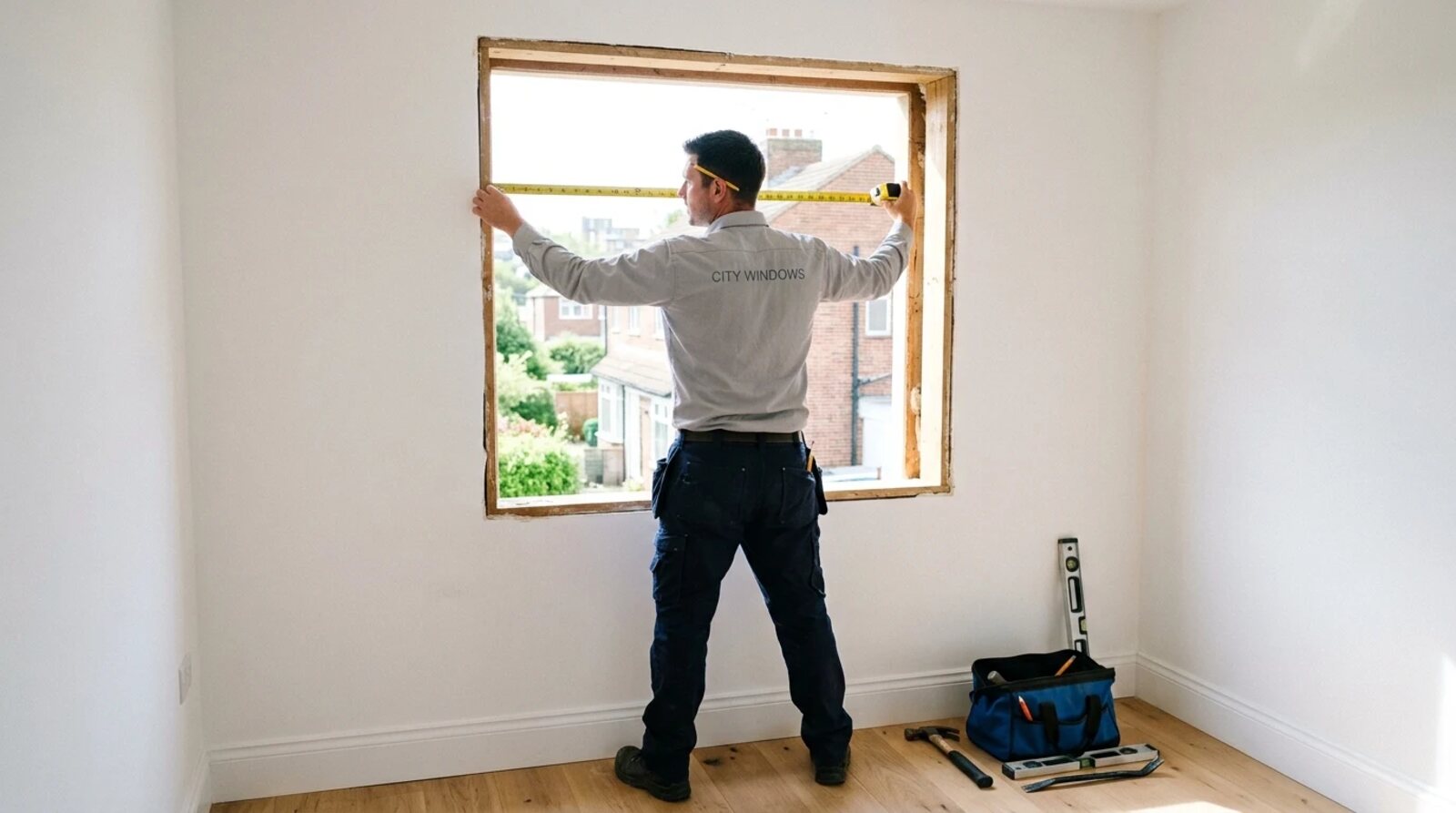
When the installer comes to your home, that is the moment to ask. You do not need to know about windows. You need to know what to ask, and to notice whether the answers are clear. Here are 10 questions, each with the reason and what a good answer sounds like.
Take the list on your phone and write the answers down. Then ask that the essentials go into the quote. What was only said aloud is easy to forget.
The 10 questions
1. Will you take the final measurements yourselves, on site?
Why: walls are rarely straight and old openings have different gaps. A wrong measurement gives a window that does not fit, and a made-to-measure window is not easy to send back.
Good answer: “Yes, we measure, after seeing the opening and removing what is needed.” Weak answer: “We already have your sizes, no need.”
2. Which frame will you use? Brand and model?
Why: “quality PVC” says nothing. Brand and model let you check what you are buying, and understand what the profile classes mean.
Good answer: gives the name and shows the technical sheet. Weak answer: “It is the best on the market.”
3. Which glass? Double or triple, with a coating?
Why: the glass changes cold, heat and noise. See Double or triple glazing. Ask also for the Ug value, which measures the heat passing through the glass.
Good answer: describes the make-up and explains why they recommend it for your home. Weak answer: “Thermal glass”, and nothing more.
4. How will you seal around the window?
Why: this is where air and water usually get in. It is the part of the installation that counts most. Fixing it well, filling the gap with the proper material and sealing inside and outside makes a big difference.
Good answer: describes the steps and the materials. Weak answer: “We put silicone and it is fine.”
5. Who does the job: your own team or a subcontractor?
Why: you want to know who answers if something goes wrong. A subcontracted team is not a problem in itself, but the company should stand behind the work.
6. Does it include removing the old windows, taking away the rubble and repairing the wall?
Why: much of the price difference is here. If it is not stated, it may appear as an extra at the end. See How to read a window quote.
7. How many days does it take and how long will we be without a window?
Why: you need to plan the home, especially in winter. Also ask what happens if it rains or if there is a delay.
8. What warranty do you give, in writing? What does it cover and for how long?
Why: a spoken warranty is not worth much. Ask that it says what it covers (frame, glass, hardware, installation) and who to call. See Warranties and certificates.
9. How do I ventilate the home after the change? Do you advise vents?
Why: new, well-sealed windows trap humidity. Before, air got through the gaps. Now the occupant has to air the home, or the home needs an air inlet. See Window condensation.
Good answer: talks about airing every day and, where needed, about vents or ventilation. Weak answer: “That is not needed.”
10. If there is a problem after the job, who do I call and how fast do you come?
Why: after-job support is part of the service. Ask whether there is a direct contact and a reply time.
An example of a visit
Maria receives the installer on a weekday afternoon. Instead of staying quiet, she opens the list and asks the first question. He answers that he measures the walls, window by window, and starts working. She asks about sealing and he explains how he fixes the frame and closes the gap. When she reaches the warranty, he says he will send it in writing, with the quote. The next day, the paper arrives.
None of this was difficult. It was enough to ask calmly, one thing at a time, and to ask for it in writing.
How to listen to the answers
Good answers are clear, short and say “in writing”. Weak answers dodge the question, change the subject or say “that is not needed”. If you do not understand, ask again, with an example.
If the installer does not know the answer to a question, the most honest thing is to say they will check. That is better than making something up. Pay attention to what the installer says without being asked: someone who explains the risks before you ask usually knows the trade.
Only have time for three?
Pick number 1 (measuring on site), number 4 (sealing) and number 8 (warranty in writing). They prevent the most problems.
The most common mistakes
- Being embarrassed to ask. Nobody expects you to know about windows. Asking is normal.
- Accepting answers over the phone that then do not appear in the quote.
- Talking only about price. Whoever only asks “how much” gets only a number.
- Not taking notes. A week later the answers from different companies blur together.
- Deciding on the spot, at the visit, only because the person was friendly.
Mini-glossary
- Opening (reveal): the hole in the wall where the window sits.
- Sealing: what closes the gaps so no air or water gets through.
- Ug: heat passing through the glass. The lower, the better.
- Hardware: hinges, locks and handles.
- Subcontractor: someone from another company who does part of the work.
After the visit
Ask that everything that was said goes into the quote. Compare it with the others using the Checklist before hiring. If two answers differ for the same question, call back and ask them to clarify.
What to do next
- Have not asked for quotes yet? See How to ask for a quote.
- Want an idea of the figures? Use the calculator.
- Want to understand what changes the price? Read How much do PVC windows cost.