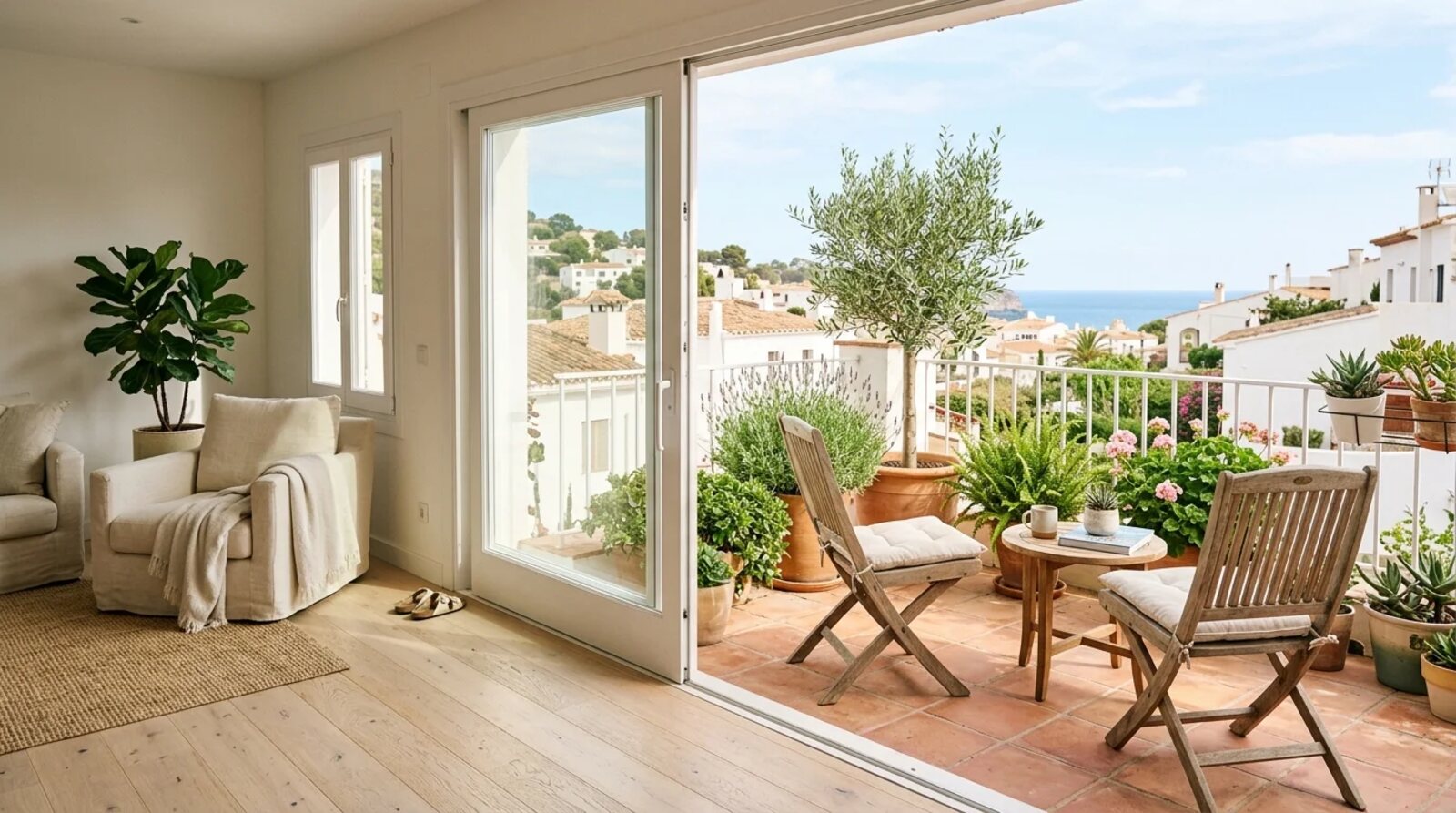
A sliding window takes no room: the sash moves sideways and never hits curtains, a kitchen worktop or a plant pot. That is why you see it on balconies, in kitchens and on doors to the terrace. The price of that advantage sits in the joints and in the rail (the track the sash runs in), and that is where a good sliding window and a poor one part ways.
The guide to opening types already compares sliding and opening windows. Here we go deeper: the sliding systems, the seals, the rail, the weight of the glass in big doors and what the quote should say in writing.
Sliding systems in plain words
- Simple sliding (correr simples). The sashes run in tracks in the frame. In a two-sash window, usually one moves and the other stays fixed, so the usable opening is close to half the width. Aluminium sliding systems have 2 or 3 tracks and can have up to 6 sashes.
- Parallel sliding (correr paralela). When you turn the handle, the sash moves slightly away from the frame and only then slides, parallel to the wall. In principle, this releases the seal before the sash moves.
- Tilt-and-slide (oscilo-paralela). Works like the one above, but the sash can also tilt at the top for ventilation, as in a tilt-and-turn. Not every model has it, so check that it is in the quote.
- Lift-and-slide (elevatória-deslizante). Turning the handle raises the sash slightly onto small wheels (rollers). When you close it, it comes down and rests on the seals. This is the answer for big, heavy sashes.
Why it seals less
ADENE, the Portuguese energy agency, writes that, in energy terms and as a general rule, sliding windows perform worse than casement windows because they let more air through. The reason is simple: a sash that slides cannot press hard against its seal, or it would stop sliding. The moving parts usually carry pile seals (brush strips), which cover the gap but do not close it like a compressed rubber gasket.
Lift-and-slide gets around the problem: the sash comes down at the end and rests on the seals, and one Portuguese manufacturer describes that seal as practically airtight (that is sales wording, so ask for the class). Where air passes, sound passes too: see sound insulation.
Not every sliding window is poor. In one manufacturer’s technical table, its sliding systems had air permeability in class 3 and 4 (the scale runs from 1 to 4, and 4 lets the least air through). Always ask for the value of the system you are offered.
The rail: cleaning, drainage and why it jams
The rail collects dust and sand. When dirt builds up, the sash drags and may stop closing properly. One manufacturer’s manual says to clean the rails of sliding elements regularly with a vacuum cleaner.
The rail also deals with water. Rain running down the glass falls into the track and has to leave through drainage openings to the outside. If they are blocked, the water stays and ends up indoors, even with the window closed. So:
- clean the drainage openings and the small drip slots (the grooves where the water exits) with a small brush or the vacuum;
- do not block them, with silicone or with paint;
- lubricate only what the manual says. One manufacturer says to put lubricant on the moving hardware only and not to let it reach the surface of the profile.
Big openings and balcony doors: the weight of the glass
Glass weighs about 2.5 kg per square metre for every millimetre of thickness. A double glazing unit with two 4 mm panes therefore weighs about 20 kg per square metre. A sash 1.2 by 2.2 m comes to about 53 kg in glass alone. Triple glazing adds weight, and the frame has to carry it.
Each system has a maximum weight per sash. In one range of sliding aluminium, for example, the limit runs from 400 kg to 800 kg depending on the system. For very heavy sashes, another manufacturer says lift-and-slide carries bigger loads and allows wider openings than simple sliding. Ask for the maximum sash weight of the system and the real weight of the sash for your opening.
On a balcony door the glass reaches the floor. ADENE recommends laminated safety glass to reduce falling fragments, and says coloured glass should be toughened so it does not break from heat. Ask which glass each sash has and get it in writing.
Roller shutter box and sliding windows
On the site visit, the installer should check that the box, the shutter guides and the rail do not get in each other’s way. Ask how you reach the box for repairs. There is more in the roller shutter box guide.
PVC or aluminium for a sliding window
The general comparison is in PVC vs aluminium. Sliding adds one detail: aluminium sliding systems exist with and without thermal insulation. One manufacturer says the non-insulated version is the most economical for glazing in a balcony, and also offers thermally insulated versions. For a heated living room, the insulated version is the logical one (see thermal-break aluminium windows).
Wind, rain and what to ask for in the quote
Exterior windows and doors sold in Europe carry the CE mark and a declaration of performance with the tested classes. ADENE tells buyers to ask for the CE marking information, which is mandatory. Ask for the classes of the system and of the size you are buying:
| Class | Scale | What it measures |
|---|---|---|
| Air permeability | 1 to 4 (4 is best) | how much air passes with the window closed |
| Water tightness | 1A to 9A | the pressure at which water still does not get in |
| Wind resistance | 0 to 5 | how well the window withstands wind pressure |
A class applies to the size that was tested: a bigger opening can give a different result. In one manufacturer’s catalogue, the water tightness class of sliding systems ran from 5A to 9A, and lift-and-slide came in at 6A to 8A. That manufacturer recommends 7A to 9A for ordinary windows in heavy-rain areas and thinks 6A to 7A is very good for lift-and-slide. The tests do not include installation, which decides how water behaves at the sill and the threshold.
Before you accept, check that the quote states:
- the type of system (simple, parallel, tilt-and-slide or lift-and-slide);
- the number of sashes and tracks, and the maximum sash weight;
- the glass in each sash and whether it is safety glass;
- the air, water and wind classes of the system, and the CE marking;
- what moves the price: more sashes, a lift-and-slide system, heavier glass, insulated aluminium, a motor.
You can tick what your quote says in the quote checker.
When to choose sliding, and when not
- Choose sliding when there is no room in front of the window, when the opening is wide, or when the window gives onto a balcony where a casement would hit something.
- Choose lift-and-slide for big, heavy glass doors.
- Prefer casement or tilt-and-turn in street-facing bedrooms, in windy places and when cold or noise matter most. See tilt-and-turn windows.
Sources
- ADENE: Janelas Eficientes (2016): supports the note on sliding windows, the CE marking and laminated glass.
- Finstral: Norma europeia de produtos. Janelas e portas exteriores (classes, declaration of performance, installation) and Instruções de manuseamento e segurança. Janelas (parallel sliding, rails). Both in Portuguese.
- Lousalu: S.120 Slim Lift: supports how lift-and-slide works and its sealing.
- Sunflex: Sistemas porta de correr: supports the tracks, the maximum sash weight and the insulated and non-insulated versions.
- Glastotaal: Calculating glass weight: supports the 2.5 kg per m² per mm figure.
What to do next
- Measure your openings: How to measure windows.
- See a starting value in the calculator.
- Ask for quotes with the questions for the installer.