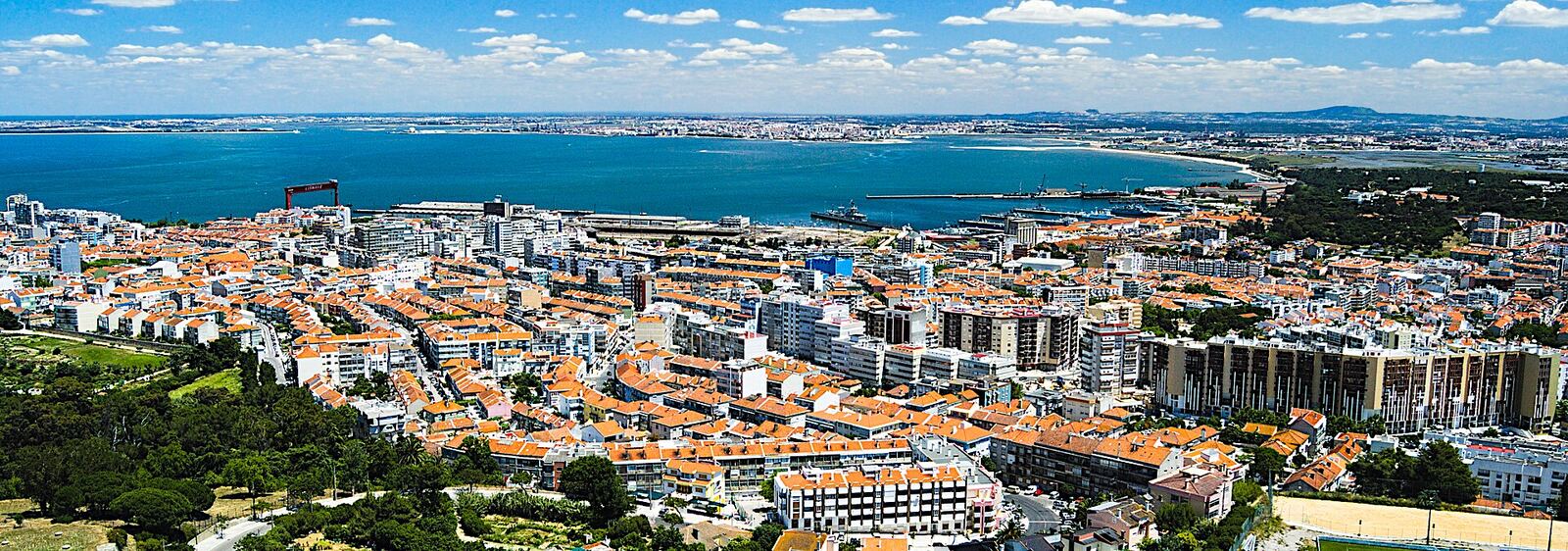
The south bank (Margem Sul) is the part of the Lisbon Metropolitan Area on the other side of the Tagus. Here we call the south bank the nine municipalities of the Setúbal peninsula. This guide gathers what our town pages say about seven of them and shows what the windows have in common: damp from the estuary, old industrial districts, fast growth, noise from trains and roads, and salt and wind on the coast. For your own home, open the page of your town.
The region in a few numbers
According to Wikipedia (the Portuguese page “Península de Setúbal”), the peninsula has nine municipalities (Alcochete, Almada, Barreiro, Moita, Montijo, Palmela, Seixal, Sesimbra and Setúbal), 37 parishes and had 848,507 inhabitants in 2024. The most populous are Almada (183,643), Seixal (176,883) and Setúbal (124,339). The area figures on the page do not agree with each other, so I do not quote them. Wikipedia has no climate section for several of these municipalities; our pages use the climate of the region, Mediterranean, with hot dry summers and mild winters.
What south bank windows have in common
Damp from the river more than salt. In Seixal, the bay and the salt marsh make the air damper in the morning and evening, and the page says the windows live more on damp than on salt. In Barreiro, the river and the tidal channels bring damp air on cold mornings and nights. In Montijo, the estuary brings damp and some salt. Airing every day counts as much as the glass. See the condensation guide.
Salt and wind on the coast. In Almada, the Costa da Caparica has salt, wind and fine sand that builds up in the tracks of sliding windows. In Sesimbra, salt from the harbour reaches the window every day and at the capes the wind is stronger.
Industrial districts and old homes. Barreiro grew with the CUF works and the railway, and has districts of working-class blocks and houses several decades old. Seixal had shipyards and factories and keeps old estates and houses. On both pages the advice is the same: openings that are not square, measurements taken on site and a quote that says how the join with the wall is done.
Fast growth, very different homes. According to our pages: Corroios (Seixal) had about 50,800 inhabitants in 2021 and 25,500 in 1981; Fernão Ferro (Seixal) had about 20,800 and nearly doubled since 2001; Pinhal Novo (Palmela) had about 27,000, against 15,400 in 1991; Quinta do Conde (Sesimbra) had about 28,100 and began as an illegal subdivision, with each owner building their own house. We found no data on the age or condition of homes in any of these parishes. Ask for each window to be measured on site.
Noise from trains and roads. In Barreiro, near the boat and train terminal, there is more movement in the late afternoon. Corroios has had Fertagus service since 1999, and at Pinhal Novo the Fertagus, CP, Intercidades and Alfa Pendular stop. We found no noise measurements for Pinhal Novo. In Almada, the newer urban areas have more road and metro noise. Double glazing and good sealing, plus a shutter box in good condition, help. See double glazing, Low-E and argon.
Town by town
Each sentence comes from the town’s own page.
- Almada: a plateau with cliffs over the Tagus, facing Lisbon, and the Costa da Caparica plain by the Atlantic; the wind changes from river to ocean and the large openings on the cliffs call for strong locks and seals.
- Seixal: a flat town around a bay of the Tagus, with damp air and wind; it has sections on Corroios and Fernão Ferro.
- Barreiro: a former working-class town by the river, with worn frames, damp walls and noise near the terminal.
- Montijo: a municipality in two parts, one by the estuary (damp) and one about 15 km to the east, drier and hotter in summer.
- Palmela: the inland peninsula, no sea spray; what counts is the wind on the castle hill, dust, heat and cold nights. Includes Pinhal Novo.
- Sesimbra: facing the Atlantic, with salt and wind, fishermen’s houses by the harbour and Quinta do Conde.
- Setúbal: the mouth of the Sado by the Arrábida, with old buildings in the centre and fishermen’s districts on slopes, such as the Fontainhas.
Alcochete and Moita do not have their own page yet. If your home is in one of them, write the locality in the request.
Airport noise: the Menos Ruído programme
According to our page on the Menos Ruído programme, the programme pays for replacing windows, frames and shutter boxes for people living near Lisbon airport, in permanent homes and in zones above certain noise levels. It has 10 million euros and agreements with four town halls: Lisboa, Almada, Loures and Vila Franca de Xira. Each runs its own call. On the south bank, only Almada is among them. The page says Almada has its own regulation and that it could not confirm the text, the budget or the dates. If your home is in another municipality, ask your town hall.
What to do next
- Build the window you want in the calculator.
- See what drives the price: PVC window prices. There are no south bank prices here.
- In a block of flats, start with the Can I replace my windows? test.
- See the grants for windows in force.
- With quotes in hand, check them in the quote checker.
What I could not confirm
- Climate data for the south bank: Wikipedia has no climate section for several of these municipalities, and the town pages use the regional climate.
- The age and condition of homes and windows by parish.
- Noise measurements anywhere on the south bank.
- The regulation, the budget and the dates of the Menos Ruído programme in Almada.
- Whether Alcochete and Moita have anything different for windows: they have no page.
- Whether each municipality has local grants beyond those described on the national pages.
Sources
Read on 23 October 2026 or, for the town pages, on the dates given in them.
- Wikipedia: Península de Setúbal (in Portuguese): municipalities, parishes, population in 2024.
- Wikipedia: Área Metropolitana de Lisboa (in Portuguese): the 18 municipalities of the metropolitan area, among them those of the Setúbal peninsula.
- Town pages and their sources (Wikipedia, in Portuguese): Almada, Seixal, Barreiro, Montijo, Palmela, Sesimbra, Setúbal.
- The source for the Menos Ruído programme is our page on the Menos Ruído programme, which cites the Government portal (22 January 2026).