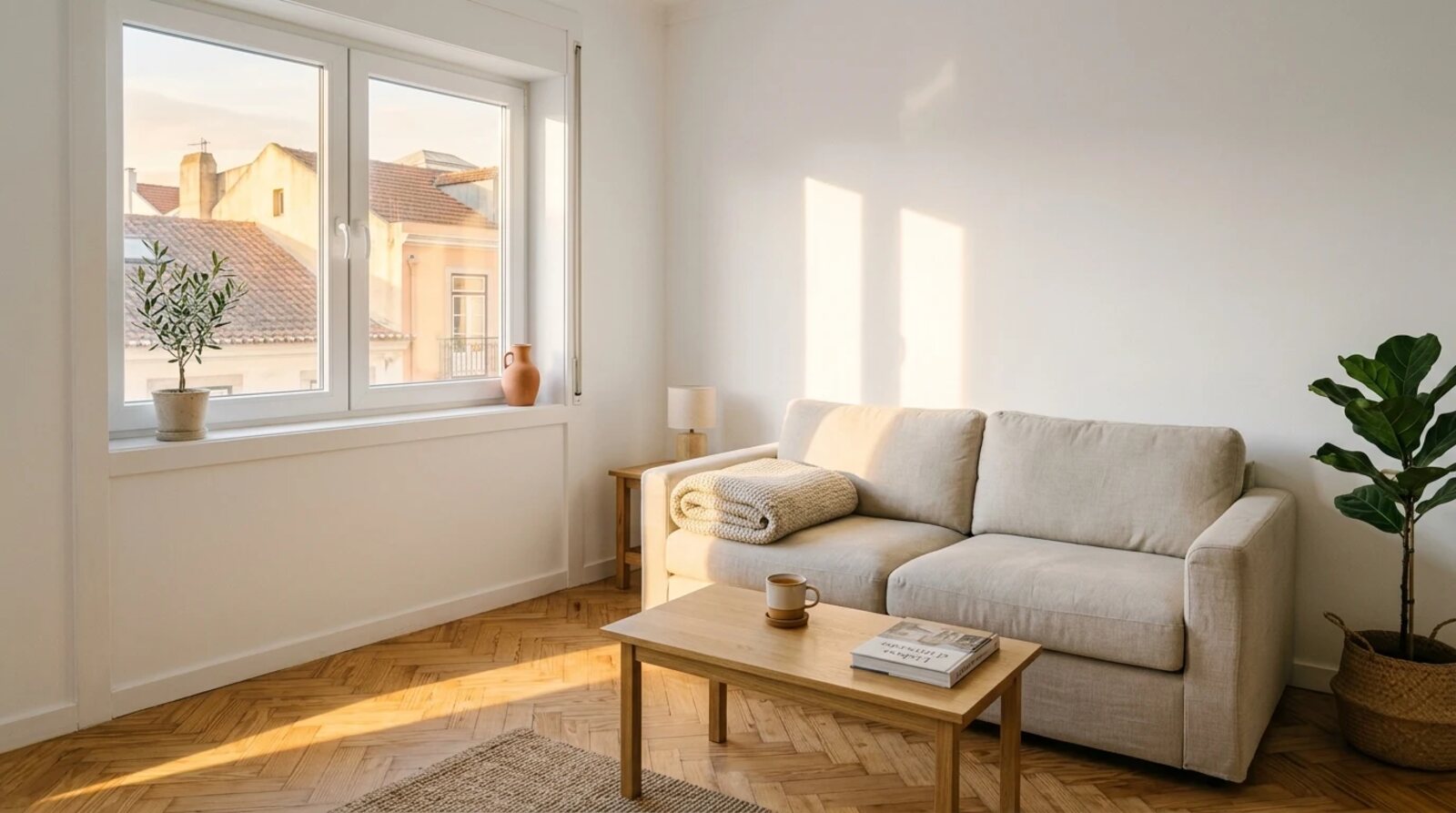
A window is the weakest spot of a wall for heat. In winter the heat inside tries to leave. In summer the heat outside tries to get in. Good thermal insulation slows down that exchange. It does not create heat or cold. What you feel at home is a steadier room, with fewer cold spots and less time running heating or air conditioning.
How heat passes through a window
- Through the glass and the frame, like the cold of a metal spoon reaching your hand. This is called conduction.
- Through the air, via gaps or air moving inside the glass. This is called convection.
- By radiation, like heat from the sun or from a heater passing through the glass.
On single glazing, the inside face really does get cold in winter. That is the “cold zone” you feel next to the window, and it is where water on the glass tends to appear.
Example: in an old flat with wooden windows and single glass, the sofa next to the window is uncomfortable all winter. With modern double glazing and good sealing, the wall of glass stops “radiating” cold and the spot becomes usable again.
The glass
The glass is most of the window. What helps:
- Double glazing: two panes with a sealed space between them, which slows down heat. A big step up from single glazing.
- Argon gas in the space, instead of air. It conducts less heat.
- Low-E coating: an almost invisible film that helps keep heat inside. There are versions designed for cold and others for strong sun; ask which one suits the orientation of your windows.
- Warm-edge spacer: the strip that separates the two panes. In some systems it is made of a material that conducts less heat, which helps at the glass corners.
- Triple glazing: insulates more, but weighs more and costs more. In many Portuguese homes, modern double glazing is enough. See double or triple.
The profile and the seals
PVC profiles have several air chambers inside, which helps insulate. PVC conducts much less heat than aluminium without a thermal break, and that is one of the reasons people choose it. See the PVC and aluminium comparison.
But it is of little use if the rubber seals are worn or the sash does not press properly. Air passing through a gap cancels part of the glass’s benefit. A side-hung or tilt-and-turn window usually presses tighter than a sliding one. See opening types.
The Uw value
Uw says how much heat passes through the whole window (glass, frame and everything). The lower, the better. Two quotes that both say “PVC with double glazing” can have very different Uw.
| Symbol | What it measures |
|---|---|
| Ug | The glass alone |
| Uf | The profile (the frame) alone |
| Uw | The whole window, at its own size |
Uw depends on size: a window with more glass and less profile usually has a different Uw from a small one. Ask for the Uw of the complete window in writing, and check that it refers to the window you will actually receive. If the seller cannot tell you, be careful.
The summer sun
Insulating is not only about keeping heat in. In summer, the sun coming through the glass warms the house. The value that measures this is called the solar factor (g). A west-facing window with no shade may need solar-control glass, or shutters or blinds on the outside. Ask the installer what is advised for your most exposed windows.
Installation and ventilation
If the window is well installed, the Uw on paper comes close to what you feel at home. With gaps around the frame, a good part of the gain is lost. See how installation should be done.
Very tight windows mean you need to air the rooms. Otherwise the moisture in the air cannot leave and ends up condensing on the glass and in the corners.
Most common mistakes
- Choosing only “double glazing” without asking for the Uw.
- Paying for triple glazing on a badly installed window.
- Ignoring the shutter box, which keeps losing heat.
- Putting the same glass in every window, without checking orientation.
- Closing everything and never airing.
How to check for yourself
- On a cold day, hold a hand near the glass on the inside. If you feel “cold coming off”, insulation is lacking or there is a gap.
- Run a hand around the frame. You should feel no air.
- If there is a lot of water on the glass in the morning, the problem is moisture and ventilation, not just the window.
Do new windows save energy?
In homes with single glazing or many gaps, the difference in comfort is usually clear. The exact saving on the bill depends on the home, the climate and how it is used, so there is no single number for everyone. Be wary of promises of an exact percentage.
Mini glossary
- Uw, Ug, Uf: how much heat passes through the window, the glass and the profile. Lower is better.
- Low-E: a film on the glass that keeps heat in.
- Argon: a gas that insulates better than air, used between the panes.
- Thermal break: a cut of insulating material inside a metal profile to slow heat down. Important in aluminium.
- Thermal bridge: a spot where heat escapes faster.
What to do next
- See the big picture in energy efficiency.
- Use the calculator to get a cost idea before asking for quotes, and ask for the Uw in writing in the quote.